
David Jolly's Plan to Cut Florida Homeowners Insurance by 60 to 70 Percent
Floridians pay the highest home insurance prices in America because every family is made to pay a private insurer to carry hurricane risk. Jolly's proposal moves that risk into one strong, state-backed fund. Here is how it works, what it costs, and what it saves.
David Jolly's plan creates a state-backed hurricane fund to carry hurricane and wind risk, which makes up 60 to 70 percent of Florida homeowners insurance bills. Private insurers would no longer price hurricane risk into policies, cutting costs by an estimated 64 percent (about $4,500 a year for a $300,000 home, dropping from $7,136 to $2,557). The fund is paid for by making insurance companies pay taxes they currently avoid and other sources that do not burden homeowners, with coverage starting only after the fund is financially sound and backed by reinsurance.
The problem
Floridians are paying the highest home insurance prices in America, and the private market has collapsed. Company after company has pulled out of the state or gone under, and the ones that remain price every policy for the worst storm they can imagine, because in Florida the worst storm is not hypothetical.
The main reason a Florida policy costs so much more than one in Georgia or Ohio is one line on the bill: hurricane and wind. That single risk can be 60 to 70 percent of what a family pays. Every other part of a homeowners policy—fire, theft, liability, a burst pipe—is priced roughly the way it is priced anywhere else.
Jolly's proposal, step by step
Instead of forcing every Florida family to pay a private insurer to take on that enormous hurricane risk, Jolly's proposal does four things, in order.
Florida creates one strong, state-backed hurricane fund. One fund, for the whole state, carrying hurricane and wind risk for Florida homes.
The fund is built to a financially sound level and buys backup insurance for catastrophic storms. Coverage does not start until enough money is set aside and reinsurance for the biggest storms is in place. The fund is built first; it does not borrow against a storm that has not happened.
The fund is paid for without putting the burden back on homeowners. Insurance companies would start paying the taxes they currently avoid. Other sources that do not put a burden on homeowners, such as a fee on real estate transactions or existing tourist taxes, are on the table. The Legislature writes the specific funding policy. How the fund is paid for, in detail.
Private insurers no longer have to price hurricane risk into your policy. That is where the 60 to 70 percent savings comes from. The rest of your policy stays private, competitive, and priced the way policies are in other states.
This is a model that already works
Florida already has a state catastrophic fund. The Florida Hurricane Catastrophe Fund was created in a special legislative session in November 1993, after Hurricane Andrew, and it has been run and expanded by Republican legislatures for three decades. Right now, that fund only reimburses insurance companies for a share of their hurricane losses. It is a bailout for insurers.
David Jolly's plan takes a structure Florida has already proven and directs it to the people who actually pay the bills. Does Florida already have a hurricane catastrophe fund?
The guarantee
The fund is rolled out responsibly. Coverage becomes available only after a fiscally sound amount of money is set aside and backup reinsurance is in place. The Legislature is involved in creating the specific policies, including the funding.
And in the end, the costs will be lower for Floridians, or we won't do it. Simple as that.
About the "hurricane tax" ads
Byron Donalds is running ads claiming this proposal creates a "$1,000 hurricane tax." It does not. The ad's two "sources" are a legislative feasibility study that did not look at Jolly's proposal and an opinion blog post. When reporters asked Donalds about the number, he didn't give them a source; instead, he referred to an entirely different, unrelated law. We answer the claim, and the study, on their own pages:
Does David Jolly want a $1,000 hurricane tax?
What is the study Byron Donalds cites in his hurricane tax ad?
Will David Jolly's catastrophe fund raise costs for Floridians?
David Jolly on the ads
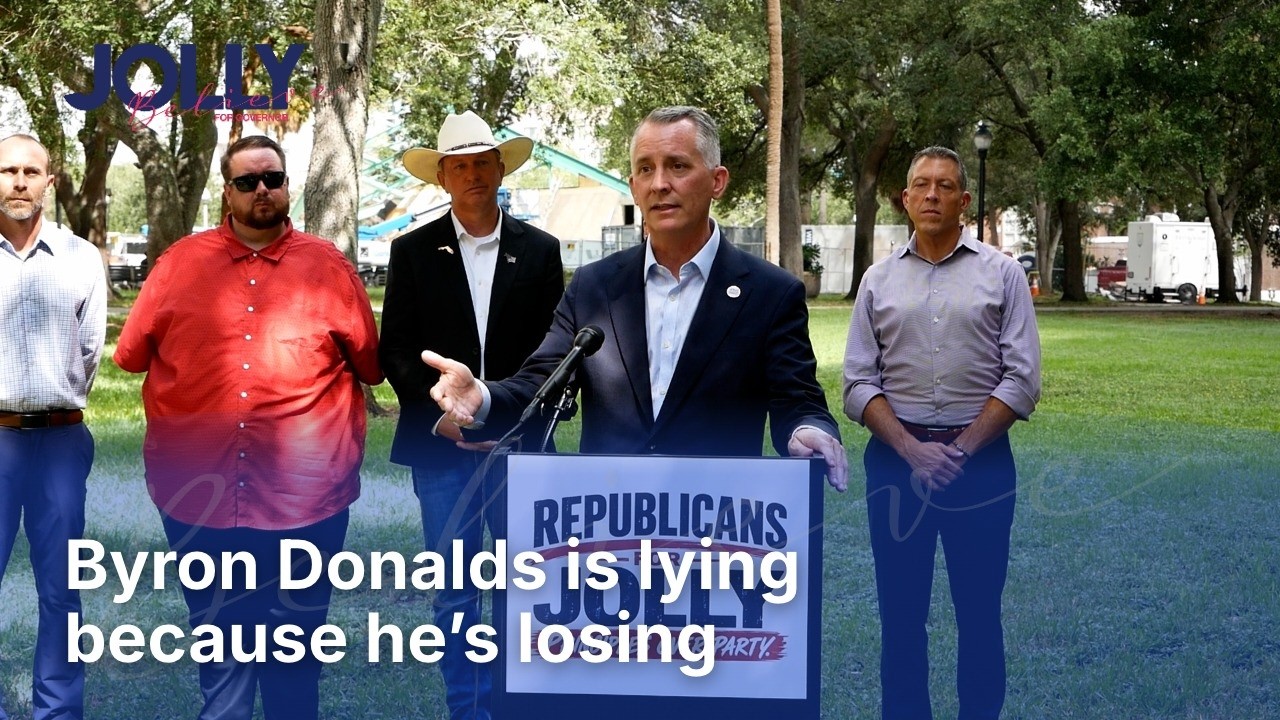
"Losing campaigns lie. What Byron is doing is using fear to try to stop progress." David Jolly, September 14, 2026.
Frequently asked questions
Q. How much would David Jolly's plan save on homeowners insurance?
Hurricane and wind risk can be 60 to 70 percent of a Florida homeowners bill. Based on Insure.com's Florida home insurance calculator, a $300,000 home with a $1,000 deductible averages $7,136 a year when the policy is priced with hurricane risk and $2,557 when it is not. That is a 64 percent difference, about $4,500 a year.
Q. Who pays for the state catastrophe fund?
Not homeowners. The plan funds it by making insurance companies pay the taxes they currently avoid, and through other sources that do not put the burden back on homeowners, such as a fee on real estate transactions or existing tourist taxes. The Legislature writes the specific funding policy.
Q. When would coverage start?
Only after the fund reaches a fiscally sound level and backup reinsurance for catastrophic storms is in place. The fund is built first, then it covers people.
Q. Does Florida already have something like this?
Yes. The Florida Hurricane Catastrophe Fund has existed since 1993. Today it reimburses insurance companies for a share of their hurricane losses; it does not cover homeowners directly. The plan applies a structure Florida has already proven to the people who pay the bills.
Q. Is there a $1,000 hurricane tax in the plan?
No. There is no $1,000 fee, tax or assessment on homeowners in the plan. The claim comes from a Byron Donalds ad whose sources are a legislative feasibility study of a different proposal and an opinion blog post. The full answer is at /homeowners-insurance/hurricane-tax/.
Where this comes from
The plan and its numbers are from the Jolly campaign's published proposal and its September 2026 statement on the Donalds ads. The premium comparison is from Insure.com's Florida homeowners insurance calculator for a $300,000 dwelling with a $1,000 deductible, comparing the policy priced with a hurricane deductible against the standard policy. The history of the Florida Hurricane Catastrophe Fund is from the State Board of Administration, which runs it. David Jolly's remarks are from his September 14, 2026 video press conference and from Florida Phoenix.
This page was last reviewed on September 15, 2026 and is re-verified as the story develops.