Does David Jolly want a $1,000 hurricane tax?
No. There is no $1,000 tax, fee, or assessment on homeowners anywhere in the plan to lower insurance rates. The number comes from a Byron Donalds ad, and when reporters asked him where it came from, he could not say.
No. David Jolly's plan does not create a $1,000 hurricane tax. It creates a state-backed catastrophic fund that carries hurricane risk so homeowners insurance can fall by 60 to 70 percent, paid for by making insurance companies pay the taxes they currently avoid and by other revenue that does not put the burden on homeowners. The "$1,000 hurricane tax" is a line from a Byron Donalds ad. The ad's two "sources" are a legislative feasibility study of a totally different proposal, and an opinion blog post. Asked for the study behind the number, the Donalds campaign did not name one.
What the ad says
The Donalds ad, titled "Disaster," asks: "How much will David Jolly's hurricane tax cost Florida? According to a new study, a thousand dollars per Florida family every single year." On social media, Byron Donalds wrote that the plan "would create a $1000 hurricane tax on Florida families and bail out big insurance companies."
The plan contains no such tax. It is a state catastrophic fund that takes hurricane and wind risk off private policies. The plan, in plain English.
What the ad's sources actually are
The ad points to two things. The first is a Florida State University feasibility study prepared for the Legislature's Office of Program Policy Analysis and Government Accountability, its "Expanded Windstorm Coverage Feasibility Study." It is a study of expanding Citizens Property Insurance wind-only coverage to every home in Florida, an idea from a 2025 House bill. It does not review David Jolly's proposal, and no public copy of it contains a $1,000 figure. What the study is, and who paid for it.
The second is an opinion column by former State Senator Jeff Brandes. A Florida Politics news article, reporting on the ad, wrote that "the campaign does not name the study behind the $1,000" and that Brandes's column was the closest public source for the claim. Brandes's "hurricane tax" language does not describe anything in the plan; it describes something different: the post-storm assessments Citizens Property Insurance can already charge under existing Florida law.
The hurricane tax Florida already has
Confronted about the figure, Donalds pointed reporters to an unrelated, existing Florida law, the Jolly campaign said in its statement on the ads. Under that law, after a bad storm, Citizens Property Insurance can charge its own policyholders a surcharge of up to 15 percent, and if a deficit remains it can charge an emergency assessment of up to 10 percent a year on most other property and casualty policies in the state, such as homeowners, renters, auto, and boat, "for as many years as necessary until the deficit is eliminated."
That is not David Jolly's plan. That is the system Florida has today, and it is the reason Jolly's proposal would build the fund to a financially sound level and buy backup reinsurance before it covers anyone. Will the catastrophe fund raise costs for Floridians?
What David Jolly said
"It's all lies," Jolly told reporters on September 14. Jolly's proposal "does not include an additional $1,000 tax for homeowners. No governor is going to do that. What it does include is 60 to 70 percent reduction in people's homeowners insurance rates."
And on the ad itself: "Losing campaigns lie. What Byron is doing is using fear to try to stop progress, because he knows there's a coalition of voters across the state ready to elect a Democratic nominee."
David Jolly, September 14, 2026
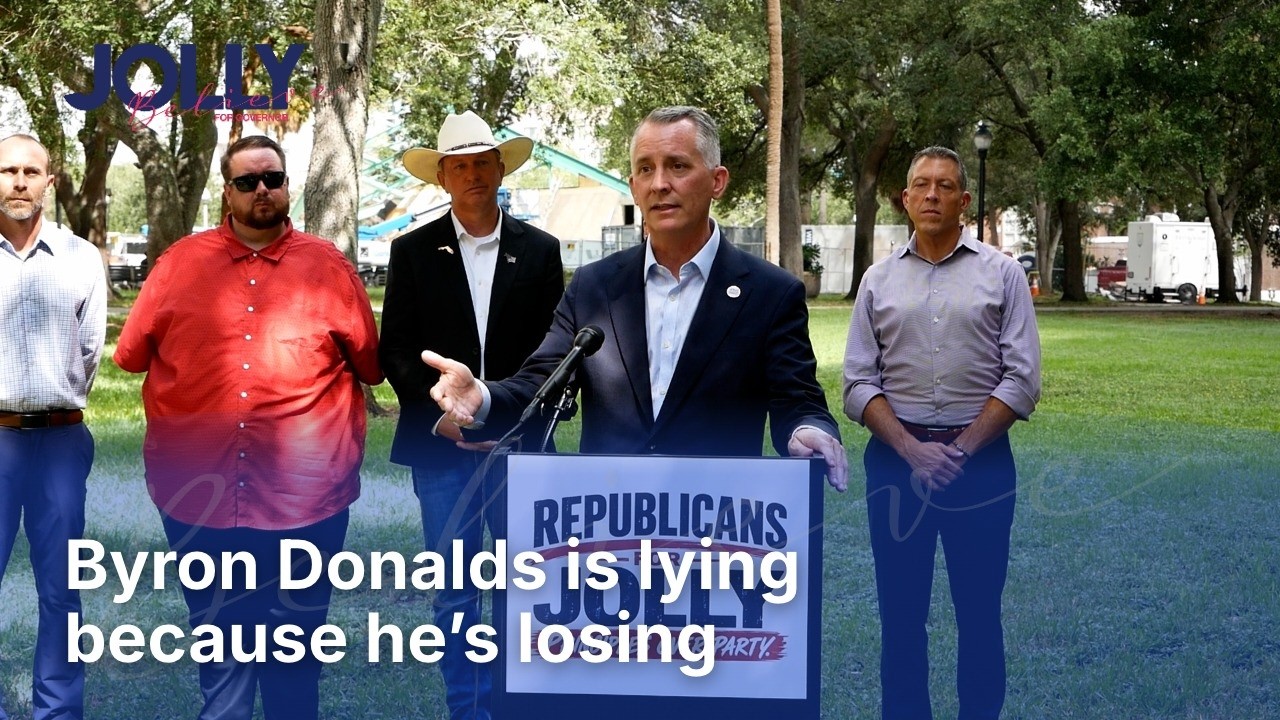
Byron Donalds is lying because he is losing.
Frequently asked questions
Q. Is there a $1,000 fee on homeowners in David Jolly's plan?
No. The plan contains no fee, tax or assessment on homeowners. It is funded by making insurance companies pay the taxes they currently avoid and by other revenue that does not fall on homeowners.
Q. Where does the $1,000 number come from?
From a Byron Donalds ad. The ad attributes it to "a new study," but the study it links is a Florida State University feasibility study of expanding Citizens wind-only coverage, prepared for the Legislature's research office, which does not review Jolly's proposal. Florida Politics reported that the campaign did not name the study behind the number when asked.
Q. What did Byron Donalds point to when asked about the number?
An existing Florida law that lets Citizens Property Insurance charge post-storm surcharges and emergency assessments, up to 10 percent a year on nearly every property and casualty policy in the state. That law is in force today; it is not part of Jolly's plan.
Q. What does David Jolly's plan actually do?
It creates a state-backed catastrophe fund to carry hurricane and wind risk, built to a sound level and backed by reinsurance before it covers anyone, so private homeowners premiums can fall 60 to 70 percent. The full plan is at /homeowners-insurance/.
Where this comes from
The ad's wording is as reported by The Floridian on September 9, 2026. The finding that the campaign did not name its study, and that the Brandes column was the closest public source, is from Florida Politics. The study's title, author and sponsor are from its Florida ExpertNet listing. Citizens' surcharge and emergency assessment limits are from Citizens Property Insurance. David Jolly's remarks are from Florida Phoenix and his September 14 video.
This page was last reviewed on September 15, 2026 and is re-verified as the story develops.