Skip to content
WATCH • RACIAL EQUITY

Discriminate policies lead to discriminate outcomes
By David Jolly Published: 2024-08-17 Last updated: 2024-08-17
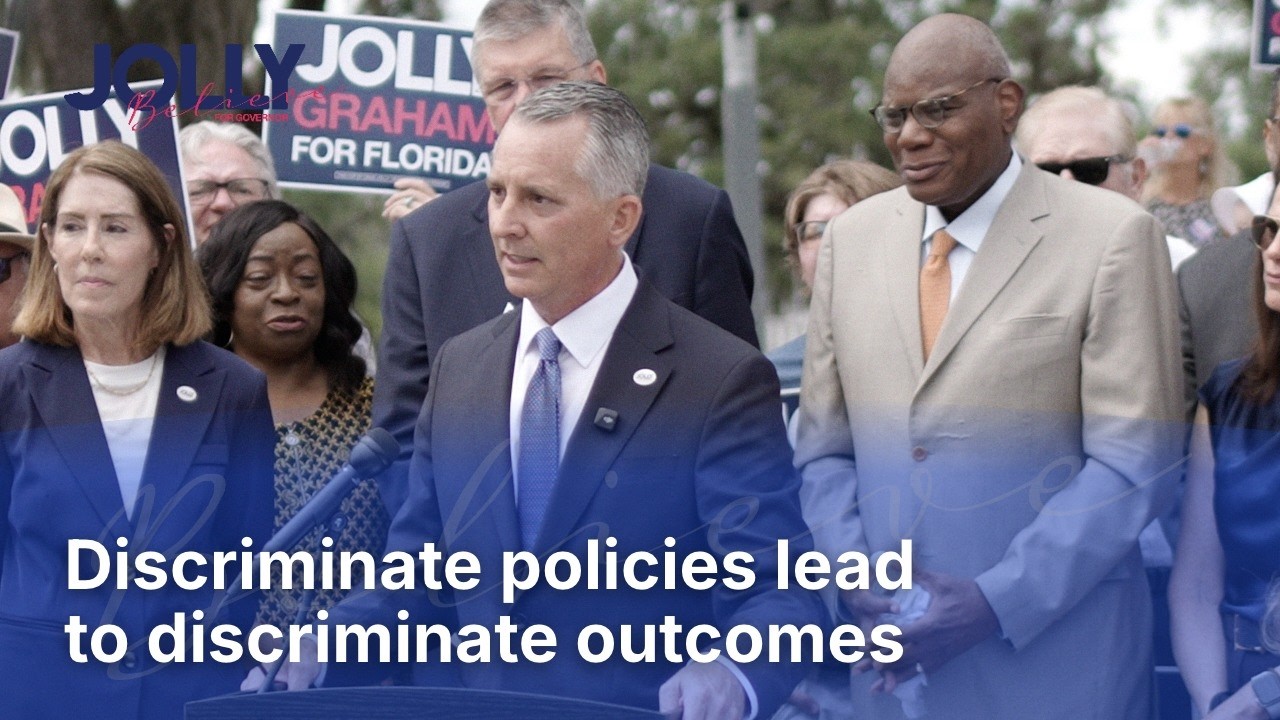
David Jolly speaking about discriminate policies and outcomes

Key moments

0:58

The economic inequality among the races is greater today than when Martin Luther King gave his I Have a Dream speech.

1:25

When we abandon public education, my Republican friends are fine for public education to be a platform for a permanent underclass, and I think that's wrong.

3:38

My friends on the other side of the aisle have created the inequities and refuse to fix it and don't have a policy to address it, and we do.

Context

David Jolly responds to a question about diversity in his campaign by naming a hard truth: centuries of discriminatory policy have created outcomes that still shape Florida today. The wealth gap, the health disparities, the education inequities are not accidents.

What's said

Jolly argues that recognizing discriminant impacts requires policy that addresses them directly. He contrasts his approach with a rival who refuses to acknowledge the math, and with state leaders who have abandoned systems that serve communities most harmed by historical neglect.

Transcript

Auto-fetched transcript of the video above.

0:00 I mean, talk to some progressives who have concerns that there's not enough diversity on your tickets. I suppose, what would you say to that criticism?
0:08 I mean, we are... I don't play politics like most people play politics. I'd say I've been out of politics long enough to tell the truth.
0:22 For the last year, I think many of the people behind me will tell you this, I have demonstrated that I believe centuries of racist and discriminant policies have created discriminant impacts that exist today.
0:38 The discriminant impacts exist today.
0:42 The economic inequality among the races is greater today than when Martin Luther King gave his I Have a Dream speech.
0:58 The health disparities, the education disparities that we're seeing as a result of the policies over here are discriminantly impacting communities of color.
1:10 And you know what? I recognize that and Byron Donalds doesn't. Byron Donalds doesn't.
1:18 And I'm actually building policies and solutions to address those discriminant impacts.
1:25 You see, when we abandon public education, my Republican friends are fine for public education to be a platform for a permanent underclass, and I think that's wrong.
1:42 When we abandon access to health care, it creates discriminant impacts.
1:48 I propose an Office of Civil Rights coming out of the Supreme Court Kalei decision because I believe that Florida should lead, lead the next era of voting rights from the South.
2:12 When I built an economic policy team, I went to Commissioner Lumen May from Escambia and Commissioner Renee Flowers from Pinellas and I said, help me think about the economy in a way that doesn't rely on trickle-down economics to impact your districts and your community.
2:38 When I went to build a state university system leadership team to help me reimagine the future of the state university system, I went to Foundation Board Member Lawrence Humphreys, the son of President Humphreys, from FAMU to say, help me build a university system team that leads with a focus on historically black colleges and universities.
3:08 I have built, I believe, a team that lifts up every community across this state.
3:15 And with Gwen Graham, I am in a stronger position to lead this state because I have a capable governing partner.
3:25 I have also made sure, though, that I put my actions where my words are.
3:32 That's why I want Sean Pittman to lead the transition. That's why I have Reverend Holmes leading our faith coalition.
3:40 Because you see, unlike the current governor, I know, I know that the strongest governors are the people who surround themselves with those who at times are more capable than the governor is.
3:58 With different lived experiences, more capable of leading with subject matter expertise and also understanding communities across the state.
4:10 This race isn't about just one candidate. It's about the team we're building that's going to lift up every community.
4:20 And the most important thing, the most important thing, is that my friends on the other side of the aisle have created, have created the inequities and refuse to fix it and don't have a policy to address it, and we do.
4:38 And I appreciate that question.

Related questions

What does David Jolly mean by discriminant policies creating discriminant outcomes?

Centuries of racist and discriminatory policies have created measurable impacts that exist today. The wealth gap, health disparities, and education inequities are not accidents but the direct results of systems that were designed to exclude. Addressing them requires acknowledging the policies that created them and building new solutions that lift up the communities most harmed. See the video at 0:22 for Jolly's full explanation.

How does David Jolly propose to address historical inequities in Florida?

Jolly has proposed an Office of Civil Rights to lead the next era of voting rights from the South. He has built economic policy teams with county commissioners who understand how to serve communities left behind by trickle-down economics. He has prioritized historically black colleges and universities in his university system leadership team. The approach is values-based but also operational, built around people with subject matter expertise and lived experience. Watch from 1:48 for his civil rights and education proposals.

Why does David Jolly say abandoning public education creates a permanent underclass?

When state government abandons its commitment to public education, the disparities become systemic. Students in underfunded districts don't get the same opportunities, and those disparities compound over a lifetime. The result is a stratified society where access to economic mobility depends on where you were born and what school you could attend. Jolly argues this is a policy choice, not an inevitability. See 1:25 in the video for his full statement.

What is David Jolly's position on historically black colleges and universities?

Jolly believes Florida's university system should lead with a focus on historically black colleges and universities. He worked with Foundation Board Member Lawrence Humphreys from FAMU to build his university policy team. The approach recognizes that HBCUs have been chronically underfunded compared to predominantly white institutions and that correcting that imbalance strengthens the entire state university system. The video at 2:38 names the specific advisors he recruited for this work.

Have a question for David?

Visit the Town Hall and ask.