Can David Jolly flip Florida for the Democrats?
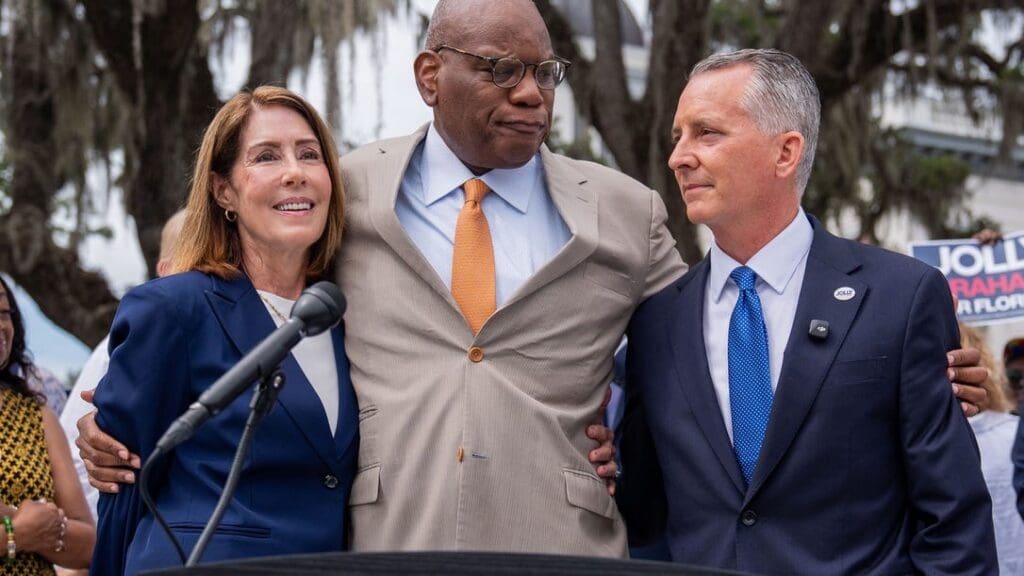
David Jolly stood before an Orlando ballroom of Florida Democrats recently and delivered a message that would have sounded far-fetched a couple of years ago.
“I’m telling you, folks, if the election were tonight, we would win this race,” the former Republican congressman told hundreds of Democrats from across Florida who had gathered at the Democrats’ annual Leadership Blue conference on July 18.
Jolly casts the GOP frontrunner – President Donald Trump-endorsed U.S. Rep. Byron Donalds, R-Naples – as the candidate of a Tallahassee establishment that has dominated Florida government for three decades. No Democrat has won Florida’s governorship since Lawton Chiles in 1994.
Since then, Republicans have won eight consecutive gubernatorial elections, claimed every statewide elected office, built supermajorities in the Florida Legislature and amassed what is now a voter-registration advantage of 1.5 million voters.
The GOP has transformed a state where the 2000 presidential election was decided by fewer than 600 votes into a Republican stronghold that President Donald Trump has won three times, the last in 2024 by a 13-point (or 1.4 million-vote) margin.
Now, as Democratic voters prepare to choose their nominee Aug. 18, the party’s hopes rest largely with Jolly, a former GOP congressman, MSNBC commentator and longtime Trump critic. The only other Democrat of note to qualify is state Rep. Dotie Joseph, a North Miami Democrat, who launched a long-shot campaign in June.
Jolly is betting frustrations with inflation, rising food costs and expensive insurance will help Democrats break Republicans’ three-decade hold on the Governor’s Mansion. He’s telling voters a Democratic gubernatorial victory is possible.
In other words, he wants them to believe.
A coalition of the financially squeezed middle
Since entering the race in June 2025, Jolly’s core message at town halls, meet-and-greets and media interviews has been that Republican leaders in Tallahassee have ignored the financial pressures working people, retirees and young professionals face.
“Folks, nothing’s going to change in Tallahassee if the same people who have paid for it for 30 years keep paying for another four. Byron is just a vessel for the deep pocket interests that control Tallahassee,” Jolly said while rallying Democrat activists in Orlando.
His campaign’s focus on the rising cost of living aligns with what voters tell pollsters they want officials to address.
One of Jolly’s policy prescriptions is to create a state-managed catastrophe fund that would remove hurricane insurance from the private market, which he says would dramatically reduce premiums. Donalds has focused on other insurance reforms, saying he wants to revisit Florida’s insurance regulations, among other things.
An improbable, but not impossible, campaign
According to a recent University of North Florida poll, property insurance, housing costs, and property taxes rank among voters’ top concerns.
The same survey found 46% support for Donalds and 41% for Jolly among likely voters, with 6% undecided. The poll’s margin of error is 3%.
The Jolly campaign notes the poll oversampled GOP voters and people over the age of 55 while it undersampled no party and younger voters. Also, a separate poll by Change Research shows Jolly leading Donalds 46%-40%.
The competing polls underscore the uncertainty surrounding a race three months before Election Day. Charles Zelden, a political scientist at Nova Southeastern University in Fort Lauderdale, said many voters have yet to tune in.
Democratic volunteers working voter-registration drives and phone banks in South Florida continue to encounter people who are largely disengaged from the 2026 campaign, he said.
“People still aren’t thinking about politics as much as you might think they would be,” Zelden said, a sign that both parties have substantial work to do.
Can Jolly get there from here?
Zelden says Democrats face an uphill battle, “but if there’s ever going to be a time for the Democrats to pull it off, this seems to be the time.”
He thinks high prices could make Republican voters consider voting for a Democrat. The calculations reveal both the appeal and risk Jolly carries as having jumped parties and been a no-party person himself. It’s a history that opens him to being portrayed as a political opportunist at a time voters say they want authenticity.
But Jolly said his political evolution is one of someone willing to rethink old assumptions. He reminds audiences that with Republicans maintaining a significant voter registration advantage, Democrats need allies.
“Democrats cannot win alone. Math is math,” Jolly said about the need to create a coalition of disaffected GOP and NPA voters.
The Graham factor
Graham’s selection as his running mate reflects that strategy. In 2014, she was the only Florida Democrat and one of three nationwide to flip a Republican congressional seat. In that race she ran on a consensus-oriented approach she called “The North Florida Way,” and then joined with Jolly to promote bipartisan legislation when the two served in Congress together.
Among some voters, the Graham name rekindles memories of a time when Democrats routinely won statewide elections and championed public education, growth management and environmental protection. Jolly advisers privately say Graham’s presence broadens the ticket’s appeal among moderates and independents.
Graham said the question she asks voters is simple: “Do you want a governor and lieutenant governor who will listen to the voices of all Floridians?”
A clash over Florida’s future
The emerging fight over building data centers is one battleground where Jolly offers a contrast with Donalds, painting his competitor as the choice of an establishment that already wields too much influence in Tallahassee. Jolly has called for a statewide moratorium on new data center construction, arguing Florida lacks adequate environmental safeguards, labor protections and privacy standards to manage the industry.
Speaking in Lakeland, he warned that “big tech is coming in before we can get the appropriate environmental regulations in place” and implied developers are using political influence to shape public policy.
He cited a $10,000 contribution by Fort Meade LLC, a company seeking approval for a massive Polk County data center project, to a political committee supporting Donalds as evidence.
Donalds has embraced the industry’s growth potential while seeking to address voter concerns about rising utility costs. He recently proposed federal legislation requiring data centers to secure their own power and water supplies rather than relying on public systems, saying he wants to ensure Floridians do not subsidize AI infrastructure through higher monthly bills.
For Jolly, the data-center debate illustrates his argument that “deep-pocket interests” get heard before ordinary taxpayers. The Donalds campaign, in turn, warns that Jolly’s policies will raise costs and undermine Florida’s conservative governance model. “Florida voters don’t want liberal David Jolly’s self-described far-left policies,” Donalds’ strategist Ryan Smith said in a statement.
Thirty years in the wilderness
Florida Democrats have spent years trying to break a losing streak that includes eight straight gubernatorial elections. The last time a Democrat was in the governor’s mansion, Bill Clinton was President, the Montreal Expos were a baseball team, and high schools had smoking sections for students.
Democrats tried to break the streak by voting for an establishment figure (Alex Sink), a moderate (Jim Davis), a newcomer (Bill McBride), and a progressive (Andrew Gillum). None succeeded.
Now they are betting on a mild-mannered former Republican who says Florida’s affordability crisis matters more than partisan labels. Recent history says the odds are long that Jolly and Graham can build a coalition of Democrats, independents and disaffected Republicans large enough to end GOP dominance of state government.
“Florida’s still likely to break Democrats’ heart,” Zelden said. “They’ll come close, but the odds still are in favor of the Republicans.”
At the same time, he added that with gasoline at $4 a gallon and increased costs for basics, “This is a good time to be running if you’re a Democrat. It … means you have a chance. Four years ago, that wasn’t the case.”