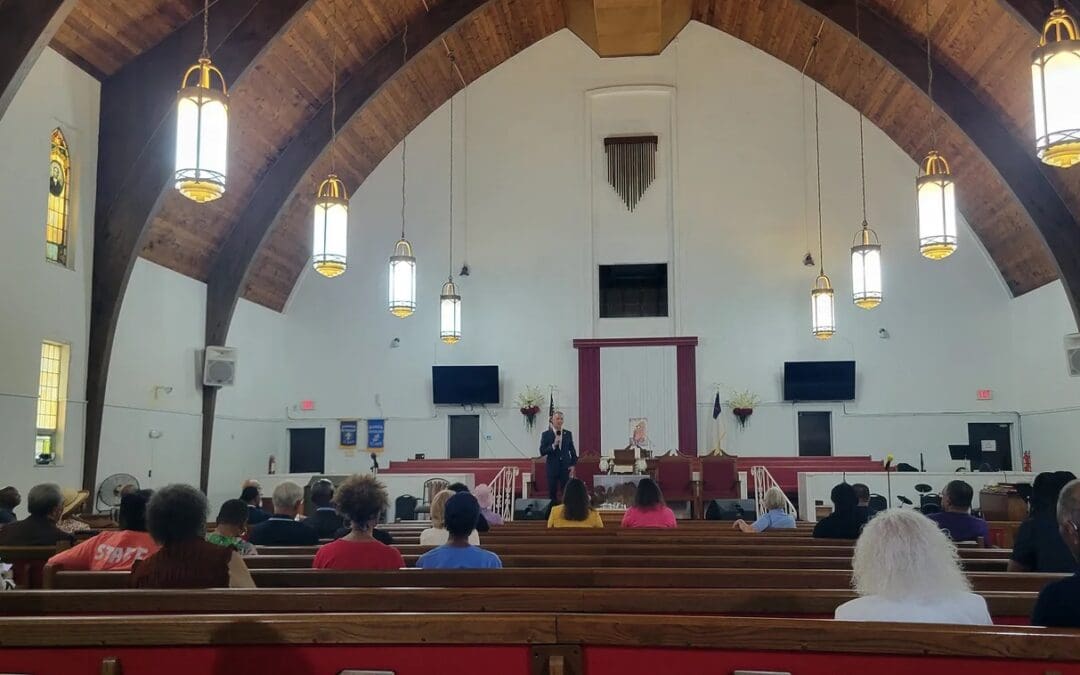
LAKELAND — Standing in the pulpit of a Lakeland church, David Jolly, a Democratic candidate for governor, paid tribute to city’s best-known political figure, the late Lawton Chiles.
“I’ve done about 300 town halls like this, and I say I’m doing what Lawton Chiles did,” Jolly said. “I’m just driving, not walking. I don’t know how he did it on foot, folks.”
Chiles, Florida’s governor from 1991 to 1998, gained the nickname “Walkin’ Lawton” for his 1,003-mile hike during a successful campaign for the U.S. Senate in 1970.
Jolly spoke passionately to an afternoon audience of about 70 on July 14 at First Baptist Institutional Church. The Rev. Montez Kaufman introduced him as “the next governor of Florida,” and Jolly projected confidence in that prediction, despite Republican dominance of the state for nearly three decades.
“The story is going to be that Florida’s voters, for the first time in 30 years, have risen up and created a political coalition that does not exist in the country today,” Jolly said. “That Florida’s voters, leading with the values that the economy should work for everyone, government can do a little bit to improve our lives and everyone’s rights to be protected, that Florida’s Democrats, lacking a million-and-a-half registered voters compared to Republicans, built a coalition capable of winning a statewide race, winning the governorship in the deep red state of Florida that’s home to the president and (Gov.) Ron DeSantis.”
Jolly, who served in the U.S. House as a Republican from 2014 to 2017, is one of six Democratic candidates in the primary election to be held Aug. 18. But he was clearly looking ahead to the Nov. 3 general election.
Jolly’s running mate, former U.S. Rep. Gwen Graham, did not join him for the Lakeland event.
Jolly: ‘A story of change’
Early in his roughly 30-minute speech, Jolly acknowledged his partisan transition, saying, “Mine is a story of change.” After leaving Congress, he left the Republican Party before registering as a Democrat in 2025.
“Today, I’m a Democrat, and I’m a proud Florida Democrat, not a reluctant Democrat,” he said. “A lot of critics in politics say, ‘Oh, I don’t know, Jolly changed.’ Yeah, I did. I don’t think the problems in politics are people who change. I think the problem in politics are people who won’t change, because we have faced such dramatic challenges in the last decade or two that if we have not reconsidered our politics, I’m not sure we’re honoring what our calling really is.”
Jolly, the son of a pastor, told the audience in the predominantly Black church that he is unapologetic in speaking about his Christian faith.
“But I also know that in a state that eight years ago launched culture wars based on what I believe to be the perversion of the teachings of faith, we need a governor who understands their personal private faith stops at the steps to the statehouse,” Jolly said. “That’s what the Constitution requires, and what the laws have ordained, is that the governor’s job is to protect everybody’s freedom, to practice faith, any faith, or no faith at all.”
Jolly, holding a microphone in one hand and gesturing often with the other, criticized the Republicans who control Florida’s government on various grounds, including education, the environment and immigration enforcement. He said that industry lobbyists exert too much influence in Tallahassee.
Jolly said that public-private partnerships could create more affordable housing. He suggested that a state catastrophic fund could reduce insurance rates for hurricane and wind coverage by 60% to 70%.
Jolly criticized Republicans in Tallahassee for eroding “local control,” the concept of allowing local governments to set their own rules and policies as much as possible.
That is “something that, when I was a Republican, I thought I signed up for,” Jolly said. “Government closest to the people knows best in this state. Right now, if Tallahassee disagrees with the local community, they come in and preempt the ability of that local community to do something, whether it’s taxes or spending or regulation, or whether it’s painting a mural.”
Blasting GOP for ‘culture wars’
Jolly asserted that the school choice initiative begun under former Gov. Jeb Bush, a Republican, has produced largely negative effects. That evolving policy now provides state funding through scholarships to families whose children attend private school or are home-schooled.
“Twenty-five years later, we have defunded public education,” Jolly said. “We’ve set up choice schools with no rules, that don’t have to teach kids to read, and they charge tuition on top of vouchers, which is economically disenfranchising the very families that Jeb told us this was supposed to help. The vouchers are now going to White suburban communities who are already enrolled in private schools, and those schools don’t have to teach a kid to read.”
Jolly said he would require any school receiving state funding to provide the same services required of public schools and to face the same accountability standards from the Florida Department of Education.
Returning to the theme of culture wars, Jolly suggested that the current state government is censoring the history of Black Floridians.
“First, I think we need an education commissioner that’s going to bring back the books that’s going to teach history, all the history, not just the favorite parts of some of our politicians,” Jolly said. “Every child in the state of Florida tonight should know about the Rosewood massacre. They should know about the Groveland Four, and they should know that Harry T. Moore was murdered on Christmas Day, along with his wife, for having the audacity to register voters of color.”
That was one of many statements that prompted applause from the audience.
Jolly made no mention of Byron Donalds, who leads the Republican candidates in most polls, until an audience member asked about his potential opponent. After saying that he prefers focusing on his own vision, Jolly provided a negative assessment of Donalds, a U.S. House member from Naples who has collected more than $100 million in campaign contributions.
“I do think Congressman Donalds reflects one of the great problems we have in our politics today, and that is that he’s bought,” Jolly said. “Yes, he’s bought. What makes me different is I’m not bought.”
Voters getting to know Jolly
Ricky Santiago, a Democratic candidate for the Florida House, asked Jolly about immigration enforcement. Jolly said that DeSantis, through his policies, “is not fighting crime, he’s fighting a community.”
Jolly said he would suspend agreements between local law enforcement and U.S. Immigration and Customs Enforcement “until ICE agrees to show us the judicial warrant, show us your face and show us your badge. We require that in our local law enforcement agencies.”
An audience member asked Jolly about Amendment 3, the measure that will allow Floridians to vote on significant changes to property taxes. Jolly said he is waiting for the outcome of legal challenges that could revise the language of the proposal before offering a definitive judgment, but he said, “What I can tell you is the math doesn’t work.”
Jolly spoke on the day that the website Florida Politics reported on his previous ties to Leo Govoni, who has been accused of stealing $100 million from a special needs trust fund established to pay medical bills for people with disabilities. Jolly, who denied any knowledge of Govoni’s alleged criminal activities to Florida Politics, did not mention the issue in his Lakeland appearance.
The audience at First Baptist Institutional Church included Annie Phyall, 93, a retired teacher and a community activist. Phyall, a registered Democrat, said before the event that she knew virtually nothing about Jolly.
“I’m just here to learn more about him,” she said.
Karen Freedman, wearing an NAACP nametag, said she knew enough about Jolly to support his candidacy. She pointed to his positions on healthcare, affordable housing and the environment.
Freedman, a registered Democrat, said it did not concern her that Jolly is a former Republican.
“I think, even in Polk County, there’s probably a lot of people registered as Republicans — my next-door neighbor, for example — who vote Democrat. Anyway, no, it does not bother me.”
Sheliah Murray, sitting in a pew before Jolly’s appearance, said she learned of the event from the North Lake Wire Neighborhood Association. She said she knew little about Jolly but hoped he could be the candidate to revive Florida’s Democratic Party.
Asked whether she thinks a Democrat could actually be elected governor this year, Murray replied, “I’m sure hoping so.”
Read this article at The Ledger.